Why Does Your Face Swell While Eating?
Have you noticed facial swelling while eating? This can be worrying. Often, the swelling appears near your jaw or cheek. It may come and go, especially during meals. For many people, salivary gland stones are the cause. Doctors call this problem sialolithiasis. Early evaluation is important. If left untreated, it can lead to pain and infection. Understanding the reasons behind this swelling helps you seek the right care.
What Are Salivary Gland Stones?
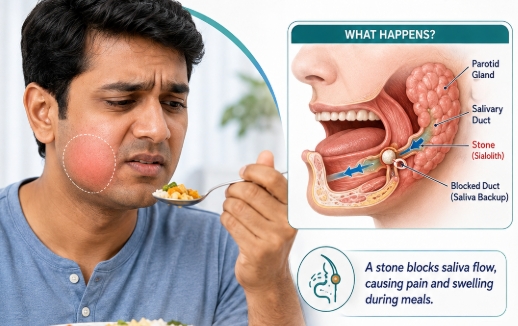
Salivary glands make saliva, which keeps your mouth moist and helps with digestion. Sometimes, small stones form inside these glands. These stones block the flow of saliva. As a result, saliva backs up, causing swelling and pain. This blockage is called salivary gland blockage. Most stones form in the glands under the jaw, but they can affect other glands too.
Why Do Salivary Stones Develop?
Several factors can lead to salivary gland stones. Understanding these causes helps prevent future problems. Common reasons include:
Additionally, some medicines and health conditions can increase your risk. But, in many cases, the exact cause is not clear.
Common Symptoms
Salivary gland stones often cause clear signs. Watch for these symptoms:
However, not everyone has all these symptoms. If you notice repeated swelling or pain, see a doctor soon.
Diagnosis
Doctors use several methods to diagnose salivary gland stones. First, they will examine your mouth and neck. Next, they may use imaging tests to find the stone. Common diagnostic tools include:
With these tests, doctors can confirm the diagnosis and plan the best treatment.
Treatment Options
Treatment depends on the size and location of the stone. Many people get relief with simple steps. However, some may need advanced care. Treatment options include:
In rare cases, surgery may be needed for large or deeply placed stones. But, most people recover well with less invasive care.
Why Sialendoscopy Is Changing Treatment
Sialendoscopy is a breakthrough in sialolithiasis treatment. During this procedure, doctors use a tiny camera to look inside the salivary ducts. They can see the stone and remove it with special tools. Because this method is less invasive, it helps preserve the salivary gland. Most patients recover quickly. Also, there is less pain and fewer complications compared to traditional surgery. For many, sialendoscopy treatment offers a safe and effective solution.
FAQs
Conclusion
Experiencing repeated facial swelling or pain during meals? Consult Asian ENT Care Center for accurate diagnosis and advanced salivary gland treatments.